Tri-Agency Narrative CV
Table of Contents
Narrative CVs
A narrative CV provides an opportunity to tell a story, connecting your experiences and expertise to your proposed research project or program. It answers the question: “Why are you the right person to do this research?” This is your chance to highlight diverse research outputs and activities. The aim is to give reviewers enough information to understand why you are qualified to do the proposed research. The narrative CV is a new format, allowing for greater flexibility and the ability to tailor your CV to a specific funding opportunity and the objectives of your research project.
While traditional CVs focus on the tip of the iceberg, the narrative CV allows you to highlight work that is often invisible (i.e., the submerged iceberg).
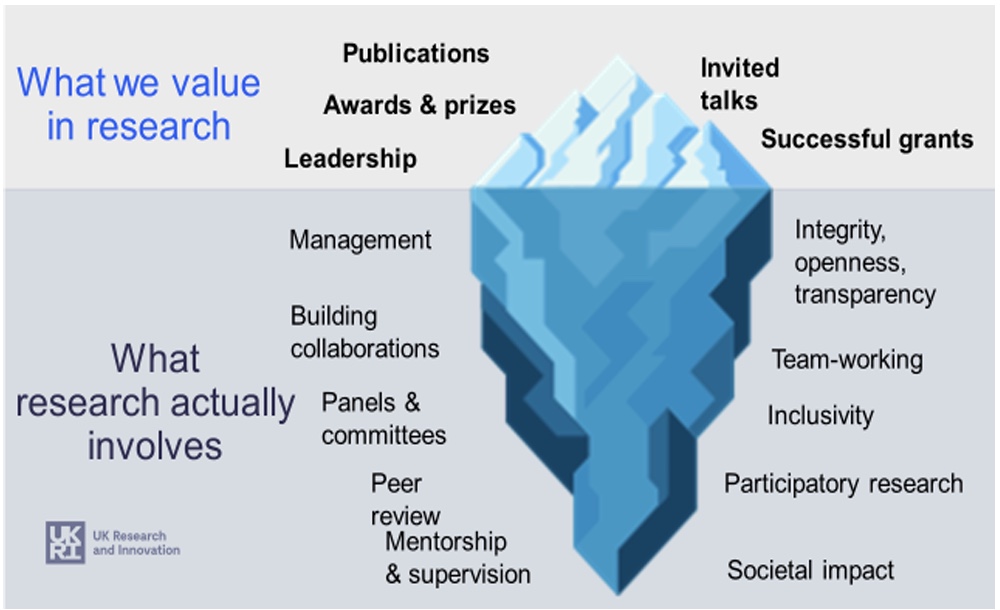
The Tri-Agencies (SSHRC, NSERC and CIHR) introduced the narrative CV to create a harmonized CV across all programs, and to reflect their “commitment to a more inclusive, diverse and holistic approach to excellence in research funding.” The Tri-Agencies are signatories to the San Francisco Declaration on Research Assessment (DORA), which urges funding agencies to prioritize research content over publication metrics, to value all kinds of research outputs in addition to publications and to consider multiple forms of evidence for research impact, including qualitative indicators.
Other countries have adopted the narrative CV (e.g., the UK’s Résumé for Researchers). The “most significant contributions” section of existing Tri-Agency grant applications already uses a similar approach.
Programs Using the Tri-Agency Narrative CV
Updated: February 2026
| Programs using narrative CV | Programs anticipated to adopt narrative CV |
|---|---|
| Canada Excellence Research Chairs | CIHR Project Grants (Spring 2027) |
| Canada Impact+ Research Chairs | NSERC Alliance Advantage (TBD) |
| CIHR Catalyst Grants (various opportunities) | NSERC Alliance Society (TBD) |
| CIHR Operating Grants | NSERC CREATE (TBD) |
| CIHR Planning and Dissemination Grants | NSERC Discovery Grants (TBD) |
| CIHR Team Grants (various opportunities) | SSHRC Insight Development Grants (TBD) |
| Diabetes Canada | SSHRC Insight Grants (TBD) |
| NSERC Arthur B. McDonald Fellowships | SSHRC Partnership Development Grants (TBD) |
| NSERC Discovery Horizons | SSHRC Partnership Grants (TBD) |
| SSHRC Destination Horizon Grants | |
| SSHRC Impact Awards | |
| SSHRC Policy Innovation Partnership Grants |
Getting Started
The Tri-Agency narrative CV has three main sections: the Personal Statement, Most Significant Contributions, and Supervisory and Mentorship Activities.
General Tips
- Start early.
- Write in first person (i.e., refer to yourself as “I”).
- Know your audience; how you write about your achievements for a multidisciplinary committee should differ from a disciplinary one.
- Think carefully about the story you want to tell in relation to the opportunity. Which research activities/impacts (both academic and non-academic) are most applicable to the proposed project and funding program? Be selective; there may not be enough space to include everything you’ve done.
- Create your narrative CV as a standalone document. It must be self-contained, without links to external content or appendices. Reviewers are unlikely to check hyperlinks.
- Use evidence or examples to support your narrative description of research impact(s).
Existing Documents You Can Use to Develop Your Narrative CV
| Documents | Personal Statement | Most Significant Contributions | Supervisory and Mentorship Activities |
|---|---|---|---|
| CFI JELF applications (researcher section) | X | X | |
| CRC nomination documents | X | X | X |
| NIH Biosketch | X | ||
| NSERC Discovery Grant (most significant contributions section and past contributions to HQP training section) | X | X | |
| NSERC Personal Data Form with CCV attachment (Form 100A) | X | X | |
| Ontario Early Researcher Award summary of researcher statement and narrative in CV | X | ||
| Prize and award nomination documents | X | X | |
| SSHRC research contributions attachment (5 to 6 pages) | X | X | |
| Teaching philosophy documents | X | ||
| Tenure and promotion packages | X |
Advice and Templates for Specific Sections
-
In this section, focus on the overall “story” of your research program and its relevance to the specific project you are proposing and the funding opportunity you are applying for.Download the Personal Statement template.
Tips:
- This section should be about 3/4 to one page long.
- Think about the central thread in your research program. What do you do? Why do you it? What is your ultimate goal or research vision?
- Include specific areas of expertise (subject area or methods), collaborations, leadership positions, recognitions (prizes, awards, etc.), lived experience and community engagement, among other contributions.
- Write in clear language for a multidisciplinary audience. If applicable, explain disciplinary norms.
- Avoid acronyms. If they must be included, write out the full term the first time they are mentioned.
-
This section allows you to showcase a range of contributions that are relevant to the proposed research project and how they advanced knowledge in your field, strengthened capacity, informed policy or had other impacts.Download the Most Significant Contributions template.
Tips:
- This section should be the most substantive part of your narrative CV and should be about three pages long.
- Avoid the one publication = one contribution model. Think creatively about how to structure your contributions thematically. This could allow you to discuss more than one output per contribution.
- Significant contributions can constitute a wide range of activities beyond academic publications (e.g., training, knowledge mobilization, EDI).
- Clearly explain not only what the contribution is, but why it is important to your field and (if applicable) society more broadly. What is the impact of the contribution? Has it advanced knowledge, built capacity, informed decision making or had economic/health/environmental/cultural impacts?
-
In this section, describe your experience training students and researchers at various levels to help readers interpret your experience and capability to train junior researchers in your field.Download the Training and Mentoring template.
Tips:
- This section should be about one page.
- Indicate how many students you have trained and at what level. You can include mentorship of research assistants, post-doctoral fellows, early career researchers and potential community members or project participants. Think broadly.
- Describe your approach to mentorship and how it equipped your students with new skills or provided formative experiences.
- Describe how you implement EDI strategies to create an inclusive research team culture and to enhance diversity in your field (if applicable).
- Detail your students’ successes (e.g., awards and scholarships, career achievements, prestigious positions obtained). These successes are evidence (at least in part!) of your effective mentorship.
- Include context such as whether you are at a research-intensive or primarily undergraduate institution and whether your program includes graduate students. This context will help shape your training track record.
- For Early Career Researchers: Describe how you have informally trained more junior researchers (e.g., as a peer mentor, as part of a larger research group or through disciplinary networks).
Developing Your Narrative CV Using Generative AI
Some researchers may consider using Generative AI (GenAI) to start a first draft of their narrative CV. As a writing tool, GenAI can be an efficient way to draft or revise materials. Instead of starting from a blank page, researchers can use AI to shape ideas into clear, structured text, making the process faster and less daunting. AI provides suggestions, improves flow and highlights key contributions, while the researcher maintains full control over accuracy and authenticity.
Using Copilot while logged into your Carleton (cunet) account, you can start by sharing the Tri-Agency CV instructions with the bot (paste the URL into the message box and hit enter). To help develop content and outputs tailored to the grant you’re applying for, you can also share any/all applicant instructions and/or other details about the competition, as well as information about your contributions (e.g., PDF of your CV, online CV). It may be more efficient to work on each section separately (personal statement, most significant contributions statement and supervisory/mentorship statement) and then workshop each.
-
Knowledge impact specialist, Raad Fadaak, describes his experience using GenAI tools to develop a narrative CV in his personal blog.- Most significant contributions: “Start with your contributions first. Try and ask the model to brainstorm contributions with you, or feed it a few of your own (as individual notes in the sidebar). Once you have those stable, then move into the supervisory section, and finally the personal statement.”
- The blank page problem: “For many researchers, the hardest part is staring at a blank page (or the barebones CV template from the agencies). This workflow can accelerate brainstorming and help you synthesize your research contributions and your personal statement into a narrative. Remember: AI is a drafting partner, not a replacement for your expertise and judgment.”
- Context matters: “Like any AI application, output quality depends entirely on what you feed it. The guidance emphasizes loading your workspace with relevant examples,… agency-specific requirements, and your actual research outputs. This contextual foundation helps the model provide feedback that’s actually useful, not generic boilerplate.”
-
Always triple-check the outputs of any GenAI platform, especially one where you are sharing personal data and asking it to develop content that represents you as an individual and scholar.Moreover, you are responsible for the accuracy and integrity of the content produced and for reading, understanding and consenting to any privacy policies. Privacy is a concern when using these tools and any data submitted to them is subject to evolving policies.
GenAI Prompt Suggestions
-
Prompt: I would like to start thinking about how to craft my personal statement section for the Tri-Agency CV format, based on my current traditional CV. Can you give me some ideas and example statements that could lead into a robust most significant contributions section?Things to consider:
- Describe why you are well suited for your proposed role and research area.
- What unique expertise, experiences or perspectives do you bring to this project?
- How has your research impacted your field or society?
- What leadership roles or initiatives have you undertaken?
- Include any lived experiences that shaped your research approach.
-
Prompt #1: Can you write me a contribution statement, of no more than 300 words, that focuses on my XYZ?*Prompt #2: Can you link my contribution X better to my personal statement, focusing on my Y achievements?*
Prompt #3: Does my contribution Y demonstrate both quality and impact per the reviewer guidelines and suggestions from the Tri-Agencies? Can I strengthen this more?
Things to consider:
- List up to 10 contributions that best demonstrate your impact. What was your role and why is it significant?
- Explain how these contributions advanced knowledge, practice or policy.
- Include diverse outputs (e.g., publications, community engagement, creative works or societal contributions).
- Highlight collaborations or interdisciplinary work that strengthened your research.
*From the personal blog of knowledge impact specialist Raad Fadaak.
-
Prompt: Can you write me a supervisory and mentorship statement, in the style of a Tri-Agency CV, that focuses on my teaching experience at X, as well as my supervision of Y and Z individuals and the work they have done?Things to consider:
- Describe how you have mentored students, trainees or colleagues. What was the outcome?
- How have you created inclusive and supportive research environments?
- What strategies have you used to foster professional growth in others?
Tri-Agency Guidance on GenAI
Read the Tri-Agency’s full statement on the use of AI.
-
- Purpose: Addresses how generative AI tools, such as ChatGPT, can be used responsibly in preparing and reviewing grant applications.
- Key Principles:
- Applicants remain fully accountable for the accuracy, completeness and integrity of their proposals.
- Privacy, confidentiality and intellectual property protection must be prioritized.
- For Applicants:
- AI can assist with efficiency and language clarity, but all sources must be properly acknowledged.
- Be cautious of AI-generated content that may omit authorship or misrepresent information.
- For Reviewers: Uploading application content into online AI tools is strictly prohibited to prevent breaches of confidentiality and IP rights.
- Policies Referenced: Tri-Agency Framework on Responsible Conduct of Research and Conflict of Interest and Confidentiality Policy.
- Updates: Guidance will be reviewed regularly as AI technology evolves.
In short, AI can be used to help write proposal documents, including the narrative CV, but applicants must ensure accuracy and transparency. Reviewers cannot use online AI tools due to confidentiality risks.
Resources
Tri-Agency Resources
- Tri-Agency CV instructions (CIHR)
- Tri-Agency CV instructions (SSHRC)
- Tri-Agency CV webinar
- Guidance for writing a narrative CV (CIHR)
- Guidelines for reviewing the Tri-Agency CV (CIHR)
- Guidelines for reviewing the Tri-Agency CV (SSHRC)
Canadian Resources
- How to write a narrative CV (University Affairs)
- Baseline competencies for writing a compelling narrative CV (University of Alberta)
- Crafting a compelling narrative CV (Concordia University)
- Narrative CV support: Most significant contributions statement (University of Calgary)
- Guidance for narrative CVs for Canada Research Chair applications (University of Winnipeg)
International Resources
Narrative CV formats vary across national and funding agency contexts, but the following resources provide good general guidance in thinking about why they are important and how to create your career narrative in relation to the funding call.
- Writing a narrative CV workbook (University of Dundee)
- Developing a narrative CV: Guidance for researchers (University of Oxford)
- A short guide to team narrative CVs (University of Glasgow)
Frequently Asked Questions
Common acronyms:
- Tri-Agency CV (TCV)
- Canadian Common CV (CCV)
- San Francisco Declaration on Research Assessment (DORA)
-
The TCV is a narrative-style curriculum vitae with three sections: personal statement, most significant contributions and experiences, and supervisory and mentorship activities. The TCV prioritizes written descriptions of an applicant’s research contributions, allowing users to highlight a wide range of research outputs and describe their career trajectories in more detail. This format values societal research outcomes, such as policy influence or mentorship, alongside more traditional research outputs, such as publications.DORA defines the narrative CV as: A CV format that provides a structured written description of a person’s contributions and achievements, reflecting a broad range of relevant skills and experiences beyond what is typically captured in a traditional academic CV.
-
The Tri-Agencies are responding to feedback from the research community regarding the usability of the CCV, particularly the burden it places on applicants to complete and update their CVs, the potential barriers it creates for collaboration and the system’s unreliability.The TCV has been designed to be more inclusive for all applicants, address usability needs and reduce the administrative burden for applicants and reviewers. It is also consistent with the three federal research funding agencies’ commitment to a more inclusive, diverse and holistic approach to excellence in research funding as signatories to DORA.
-
Please refer to the table provided above. -
Since the narrative CV follows DORA principles, quantitative metrics may be included, but only to support a qualitative description of impact rather than serve as the primary measure of quality. Here’s how to integrate them effectively:DORA-compliant use of metrics
- Contextualize every metric:
- Don’t just state numbers; explain what they mean for your field or project.
- Example: “This dataset has been downloaded over 8,000 times, enabling reproducibility and accelerating research in climate modelling.”
- Focus on contribution, not journal prestige:
- Avoid journal impact factors or rankings.
- Use metrics that reflect reach and influence, such as:
- Citation counts for a specific paper (with context).
- Software/tool adoption (downloads, GitHub stars).
- Policy citations or clinical guideline references.
- Engagement metrics for outreach activities.
- Combine qualitative and quantitative evidence:
- Example: “Our open-source algorithm has been cited in 120 publications and implemented in 10 national labs, demonstrating broad adoption.”
- Link metrics to program objectives and proposal milestones:
- Show how these numbers demonstrate capacity to deliver.
- Example: “My previous project attracted 500+ collaborators, illustrating readiness to lead the large-scale consortium required for Milestone 3.”
Checklist for DORA-friendly metrics
- Use metrics as supporting evidence, not as standalone indicators.
- Explain why the metric matters in context.
- Highlight impact on knowledge, practice or society, not journal prestige.
- Contextualize every metric:
-
The number included may vary by competition and agency. Review the guidelines and application instructions and align your contributions accordingly. It may be prudent to prioritize quality over quantity. Describing fewer well-developed contributions may be strategic because you will be better able to explain the context, your role and the impact of each contribution, including evidence, all of which takes space.To decide which contributions to include, consider the relevance of each potential contribution to the funding opportunity and to the proposed project, and select contributions that directly support both. You should also choose contributions that best demonstrate your leadership, innovation and/or influence. Finally, consider a balance across themes; your selected contributions should include a mix of research outputs, mentorship and societal impact, knowledge mobilization or technology transfer as relevant to your field.
-
Not exclusively. In a narrative CV, the most significant contributions section is meant to explain the impact and context of your work. It is not simply a list of publications. When approaching this section, organize your outputs into themes or contributions, and add a narrative explaining why each contribution matters, what problem it addresses, how it addresses it and its influence in the field. It may also be helpful to include your role. For example, were you the lead author or did you provide technical contributions?Alongside the narrative description, you can add outputs as evidence of expertise and impact, including publications, IP transfers (e.g., patents), presentations, lectures, roundtable or panel participation, mentorship and capacity building, or publication engagement that enabled societal impact.
-
Specific funding opportunities may still indicate applicable time periods for the Tri-Agency narrative CV. Applicants should read funding program details carefully.If the funding opportunity does not specify an applicable time period, instead of focusing on your productivity and impact over a shorter period, prioritize relevance and alignment with the proposed project and funding opportunity.
Things to consider when developing a framework:
- Alignment with the proposed project and funding opportunity.
- Focus on quality over quantity.
- Address all required sections and relevant criteria.
- Use strategic summaries.
- Think about the reviewer.
-
Please refer to the program guidelines of the competition or opportunity to which you are applying for formatting instructions. -
The narrative CV is designed to highlight your most influential contributions and the context behind them, rather than list all outputs and activities. The page limit ensures reviewers can focus on your key achievements and broader impact. It’s not about excluding your work — it’s about telling the story of your research journey and providing the most persuasive evidence of impact.One strategy to synthesize your outputs is to select five to ten impactful contributions and group them within areas of expertise or themes. Where appropriate, include phrases like “over 50 peer-reviewed publications in X field since 20XX” for scope.
-
The personal statement should strike a balance between authenticity and professionalism. For example, if you would be comfortable sharing your narrative CV publicly, you are likely within the scope of what the narrative CV considers “personal” in a professional sense.- Purpose: It’s meant to give reviewers insight into your motivation, values and unique career path, not your private life.
- Focus on professional identity: Share what drives your research, your commitment to advancing knowledge and your experiences that shape your approach.
- Include context: When highlighting your expertise, experiences and, if relevant, personal influences, ensure they directly relate to your research and the proposed project (e.g., a lived experience that inspired your research focus).
- Avoid overly private details: Keep it relevant to your professional journey; avoid unrelated personal anecdotes.
-
Yes, even if the format is standardized, different funding agencies will expect different emphases in a narrative CV because their program objectives, evaluation criteria and priorities vary. The same is true across different competitions hosted by the same agency. Please review the guidelines and applicant instructions carefully before preparing your narrative CV. -
You should review and update your narrative CV each time you submit it, and you should modify the content and outputs to align with the key criteria and scope of the competition to which you are applying. It is recommended that you maintain a more comprehensive CV that lists all achievements. -
Rather than simply using superlative terms, provide concrete examples to demonstrate impact. Examples may include testimonials, reviews, engagement with diverse groups, citation numbers, etc. -
It is not obligatory to divulge or discuss career delays or interruptions in your narrative CV. At the time of writing (December 2025), Tri-Agency applications provide a separate section to describe career interruptions and special circumstances. This information is then attached to your narrative CV for reviewers.If appropriate, you may choose to discuss the impact of any delays or circumstances that are not typically “counted” but that have affected your productivity in the personal statement. For example, if your rate of publication has been slow because you conduct community-based research that requires extensive consultation with community members, you could explain it in your personal statement.
-
Forthcoming publications can be included in the most significant contributions section, as long as the status for each upcoming publication is clearly labelled (e.g., in press, under review). However, given the focus of this section is on research outputs that have already achieved demonstrable impact, you should only include forthcoming publications that are highly relevant to the specific funding opportunity or proposal.
Contact Us
Depending on the opportunity, faculty research facilitators or institutional research facilitators in the Carleton Office for Research Initiatives and Services (CORIS) can help you develop a narrative CV.
You can also consult the Tri-Agency CV webpage.